
The wirehaired vizsla is a separate Hungarian gundog breed, not a long-coated version of the vizsla you already know. It was created in 1930s Hungary by crossing vizslas with German Wirehaired Pointers to produce a tougher, weather-proof hunting dog. It’s slightly bigger, slightly steadier, and needs the same enormous amount of exercise — usually more.
What Are A Wirehaired Vizsla’s Key Facts?
Here are the headline numbers before we get into detail.
| Wirehaired Vizsla | |
|---|---|
| Also known as | Hungarian Wirehaired Vizsla, Drótszőrű Magyar Vizsla, Hungarian Wire-Haired Pointer |
| Country of origin | Hungary |
| Height | Males 58–64 cm (23–25 in), females 54–60 cm (21–23.5 in) — FCI Standard No. 239 |
| Coat | Wiry, close-lying outer coat 2–3 cm long over a dense, water-repellent undercoat |
| Colour | Various shades of russet gold and dark sandy gold |
| Distinguishing features | Beard, pronounced eyebrows, harsh topcoat |
| Exercise | More than 2 hours a day (The Kennel Club) |
| Grooming | Hand-strip or comb through more than once a week |
| Life expectancy | Around 12–13 years |
| Kennel Club group | Gundog (FCI Group 7, Pointing Dogs) |
| Good for first-time owners? | Rarely — see Is A Vizsla Right For Me? |
What Is A Wirehaired Vizsla?
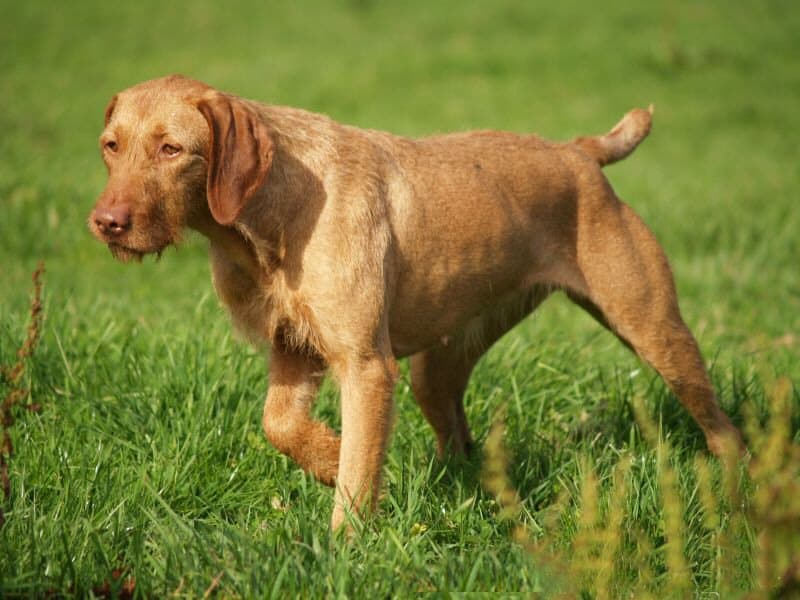
A wirehaired vizsla is a distinct Hungarian pointing breed with a harsh, wiry coat, a beard and heavy eyebrows, recognised separately from the smooth vizsla by every major kennel club. It shares the vizsla’s golden-rust colour and its bottomless need for company, but it’s built a little heavier and coated for cold, wet work.
This is the point people get wrong most often, so I’ll say it plainly. You don’t get a wirehaired vizsla by breeding two smooth vizslas. They’re two separate breeds with separate standards, separate show classes and separate breed registers.
The FCI classifies it as Standard No. 239, Hungarian Wire-haired Pointer, in Group 7 (Pointing Dogs), Section 1 (Continental Pointing Dogs). The UK’s Kennel Club lists it in the Gundog group as the Hungarian Wirehaired Vizsla. The AKC gave it full recognition in the Sporting Group on 2 July 2014.
If you’re still working out which golden-brown gundog you’ve actually been looking at, my guide to dog breeds similar to vizslas covers the whole confusing family.
Where Did The Wirehaired Vizsla Come From?
It was developed in Hungary in the 1930s by two breeders — Vasas József of the Csabai vizsla kennel and Gresznarik László of the de Selle German Wirehaired Pointer kennel — who wanted a vizsla that could keep working through a Hungarian winter.
The recorded foundation cross was two vizsla bitches, Zsuzsi and Csibi, bred to a liver-coloured German Wirehaired Pointer called Astor von Potat. The aim was blunt and practical: keep the vizsla’s colour, nose and biddability, but wrap it in a coat that could handle icy water and thorn cover. The first exhibited dog of the new type, Dia de Selle, came out of that programme.
Recognition took a while. The FCI accepted the breed in 1963, Canada in 1977, the UKC in 2006, Australia in 2007, and the AKC ran it through Foundation Stock Service in 2008 and the Miscellaneous Class in 2011 before full recognition in 2014.
In other words, this is a breed built for a job, and about eighty years old — not a designer variant. That matters, because it’s genuinely different from the vizsla crossbreeds people sometimes lump it in with, like the vizsla lab mix or the vizsla poodle mix.
How Big Does A Wirehaired Vizsla Get?
Males stand 58–64 cm (roughly 23–25 inches) at the withers and females 54–60 cm (roughly 21–23.5 inches), according to FCI Standard No. 239. The standard treats a deviation of more than 2 cm either way as a fault, so there isn’t much legitimate variation.
That makes the wirehaired a shade taller and noticeably more substantial than the average smooth vizsla — heavier bone, broader head, more dog in your lap. Most healthy adults sit somewhere in the 20–30 kg (45–65 lb) range depending on sex and build.
Don’t read “bigger” as “calmer”. It isn’t a size thing.
What Does A Wirehaired Vizsla’s Coat Actually Look And Feel Like?
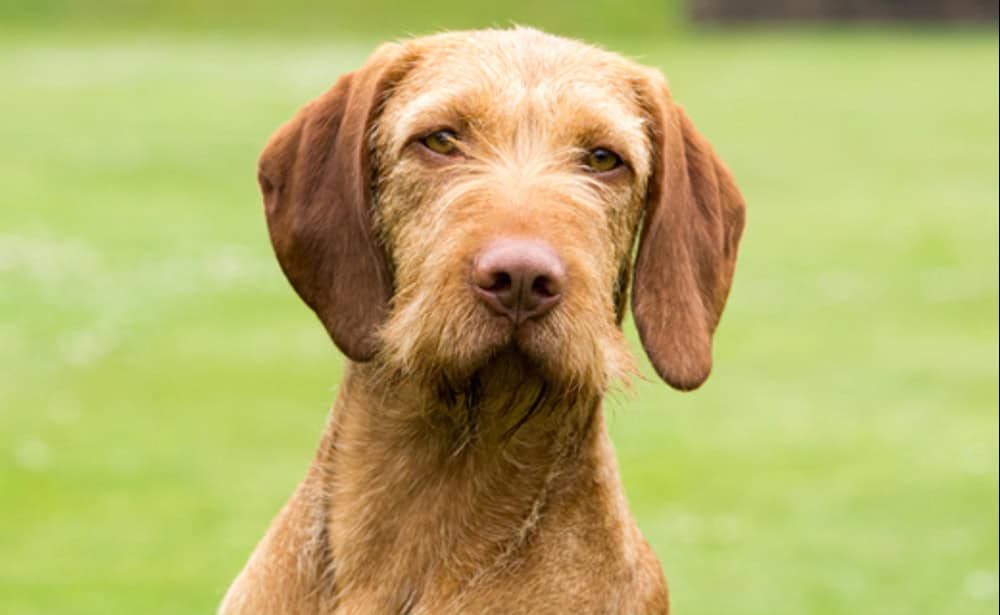
The outer coat is wiry, close-lying, strong, dense and specifically not glossy, at 2–3 cm long, sitting over a dense, water-repellent undercoat. Under your hand it feels like a stiff doormat rather than the warm suede of a smooth vizsla.
The face is what sells it. A pronounced beard on the muzzle and strong eyebrows give the breed a slightly stern, professorial look that’s completely at odds with its actual personality.
Colour follows the vizsla standard: various shades of russet gold and dark sandy gold, described in the standard by the lovely old German word semmelgelb. If you want the full range of what is and isn’t acceptable, I’ve written that up in Hungarian Vizsla colours.
A thin coat with no undercoat, or a long, soft, silky coat, is a fault in the breed standard — the harshness is the entire point.
Do Wirehaired Vizslas Shed?
Yes, but less visibly than smooth vizslas. The dead hair tends to stay trapped in the wiry topcoat instead of dropping straight onto your sofa, which is why owners often describe them as “cleaner” dogs.
Trapped isn’t gone, though. If you don’t get it out, the coat mats and the dog starts to look woolly and unkempt. My guide to whether vizslas shed covers what to expect from the smooth coat by comparison — and no, neither one is hypoallergenic.
How Do You Groom A Wirehaired Vizsla?
Comb or strip the coat through more than once a week, and hand-strip the dead outer hair a couple of times a year rather than clipping it. The Kennel Club puts this breed in the “grooming more than once a week” bracket, which is a real step up from the smooth vizsla’s five-minute-a-week routine.
Clipping is the mistake to avoid. Take shears to a wire coat and you cut the harsh guard hairs off level with the soft undercoat, and it grows back softer, paler and less weatherproof every time. Hand-stripping pulls the dead hair out at the root so the proper texture returns.
Everything else is the same as any vizsla: ears checked weekly, nails kept short, a bath only when they’ve found something disgusting. My vizsla grooming guide and my roundup of the best brushes for a vizsla both apply here — just add a stripping knife to the kit.
Is A Wirehaired Vizsla Warmer Than A Smooth Vizsla?
Yes. The dense, water-repellent undercoat that the smooth vizsla simply doesn’t have makes a real difference in cold and wet weather, and it thickens up over the winter months.
Real difference, not immunity. A wirehaired vizsla is still a lean, low-body-fat gundog and will still shiver on a long, wet, standing-around sort of walk in January. I go into where the limits actually are in Do Vizslas Get Cold?.
What Is A Wirehaired Vizsla’s Temperament Like?
Affectionate, deeply people-bonded and famously “velcro” — with a reputation among owners and breeders for being a touch steadier and less frantic than the smooth vizsla. They’re gentle with their families, soft to train, and genuinely miserable when left alone.
I want to be careful here, because this is where breed writing tends to drift into wishful thinking. The steadiness is a tendency reported across the breed, not a guarantee, and it varies enormously by line and by individual. Don’t get me wrong — I’ve met wirehaired vizslas who could out-fizz any smooth vizsla I know.
What’s absolutely consistent is the attachment. This is a dog that follows you to the bathroom, leans on your legs while you cook, and treats a closed door as a personal insult. If that sounds charming rather than exhausting, you’re the right sort of owner. If you want an honest look at both sides, my vizsla pros and cons piece doesn’t sugar-coat it.
Wirehaired vizslas are not a solution to a vizsla’s separation anxiety — they have exactly the same wiring.
Are Wirehaired Vizslas Good Family Dogs?
Yes, for active families with the time to meet their needs. They’re tolerant, soft-mouthed and strongly attached to children, but they’re also big, fast and physically clumsy around toddlers when they’re young.
The same rules apply as for the smooth coat, and I’ve written those up in detail in Is A Vizsla A Good Family Dog?.
How Much Exercise Does A Wirehaired Vizsla Need?
More than two hours a day, every day, according to The Kennel Club’s own breed guidance — and that should include off-lead running and scentwork, not just lead walking.
These are pointing dogs bred to quarter ground all day. An hour round the block twice a day keeps their legs tired and their brain entirely untouched, which is how you end up with a dog that redecorates your skirting boards.
What actually works, in my experience, is mixing it: a long off-lead run, some scatter-feeding or tracking in long grass, and a solid ten minutes of training. The mental side does as much as the miles. My vizsla exercise needs guide breaks this down by age, including why you shouldn’t be running a growing puppy into the ground.
What Health Problems Do Wirehaired Vizslas Have?
Hip dysplasia and eye conditions are the two the breed clubs screen for as standard, with elbow dysplasia, hyperuricosuria (HUU) and cardiac disease recommended on top.
The Wirehaired Vizsla Club of America’s health statement requires, under its Code of Ethics, that breeding stock has hips screened by the OFA after the age of two (or a PennHIP score of .70 or better) and holds a current “normal” annual eye examination. It also flags that the breed can be sensitive to vaccines and vaccine/flea medication combinations, and that some individuals have had difficult anaesthetic recoveries — worth mentioning to your vet before any procedure.
Beyond that, expect the usual vizsla list: sensitive skin, ear infections in a dog that swims, and the occasional case of epilepsy in affected lines.
Ask any breeder for the actual certificates, not a verbal assurance that “the lines are clear.” How to spot a good vizsla breeder covers what else to ask.
How Long Do Wirehaired Vizslas Live?
Around 12 to 13 years. A UK breed club health survey found a life expectancy of 12.92 years from a sample of 38 recorded deaths — a small sample, but the most breed-specific figure available, and it lines up with The Kennel Club’s “over 10 years” bracket.
That’s a good innings for a dog of this size, and roughly the same as the smooth vizsla.
Wirehaired Vizsla Vs Smooth Vizsla: What’s Actually Different?
The coat, the size and — usually — a slight difference in intensity. Everything else, from the exercise requirement to the velcro attachment, is close to identical.
| Smooth Vizsla | Wirehaired Vizsla | |
|---|---|---|
| Coat | Short, smooth, dense, glossy, no undercoat | Wiry 2–3 cm topcoat, dense water-repellent undercoat |
| Face | Clean-shaven | Beard and pronounced eyebrows |
| Height (males) | 58–64 cm | 58–64 cm, typically heavier-boned |
| Cold tolerance | Poor | Noticeably better |
| Grooming | A brush once a week | Comb 2+ times a week, hand-strip twice a year |
| Shedding | Constant, visible, everywhere | Less visible, but needs stripping out |
| Temperament | Intense, sensitive, velcro | Often a shade steadier, still velcro |
| Availability in the UK/US | Common | Genuinely rare |
I’ll be doing a dedicated deep-dive on the coat differences shortly. In the meantime, if you’re weighing the vizsla against other gundogs entirely, my vizsla vs Weimaraner and vizsla vs German Shorthaired Pointer comparisons are the two people ask about most — and the vizsla GSP mix is a surprisingly common cross of the two.
How Rare Is A Wirehaired Vizsla, And What Do They Cost?
Rare. In 2009 there were an estimated 400–450 wirehaired vizslas in the United States and somewhere between 2,500 and 3,000 worldwide, and while the numbers have grown since, this is still a breed where you join a waiting list rather than choose from a shortlist.
Practically, that means: fewer litters, longer waits, more travelling to view puppies, and prices at or above the top of the smooth vizsla range. My vizsla cost breakdown covers the lifetime figures, and most of it transfers straight across — with the caveat that the purchase price and the grooming line are both higher.
One more scarcity effect worth knowing: because so few litters are registered, some sellers describe scruffy-coated smooth vizslas or vizsla crosses as “wirehaired”. A genuine wirehaired vizsla puppy comes with breed-specific registration papers. No papers, no wirehaired vizsla.
Should You Get A Wirehaired Vizsla?
Get one if you already know you want a vizsla, you spend serious time outdoors in bad weather, and you’d rather do fortnightly coat work than daily hoovering. Don’t get one because you’ve heard they’re the “calm” vizsla.
The honest summary is that everything demanding about a vizsla is still here. The dog still needs two-plus hours a day, still can’t be left alone for a working day, still wants to be touching you at all times. What you gain is a coat that laughs at February and a dog that’s often a little easier to live with at full tilt.
If you’re not sure yet, read things you should know before getting a vizsla first. And if you’ve decided, tail docking rules are worth understanding before you view a litter, because they vary hugely by country.
FAQs About Wirehaired Vizslas
Is a wirehaired vizsla a separate breed from a vizsla? Yes. The wirehaired vizsla is a separate breed with its own standard, recognised by the FCI as Standard No. 239 and by the AKC in the Sporting Group since 2 July 2014. Two smooth vizslas cannot produce a wirehaired vizsla.
Do wirehaired vizslas shed less than smooth vizslas? They shed less visibly. Dead hair is held in the wiry topcoat rather than dropping onto floors and furniture, but it still needs combing and stripping out regularly or the coat will mat.
Are wirehaired vizslas calmer than vizslas? Often slightly, but not reliably. Many owners and breeders describe the wirehaired as a touch steadier and less frantic, but the exercise requirement, the intelligence and the need for constant human company are identical.
How much exercise does a wirehaired vizsla need? More than two hours a day, per The Kennel Club’s breed guidance, and it should include off-lead running plus mental work. Lead walking alone won’t satisfy a working-bred pointing dog.
Can wirehaired vizslas live outside in cold weather? No. The dense undercoat makes them far more weather-tolerant than smooth vizslas for working and walking, but they’re extremely people-oriented dogs that suffer badly when kennelled away from their family.
Before You Go
If you’ve read this far, you’re probably not idly curious — you’re weighing up whether this is your next dog. My honest advice is to go and meet a few. Wirehaired vizslas photograph as serious, bearded, sensible animals, and then you meet one and it puts its whole head in your lap and sighs.
Whatever you decide, get it from someone who screens hips and eyes and will still take your call in three years. That single choice matters more than coat type ever will.


